Preclinical: Prime Editing Restores...
CMN Special
Oct. 7, 2026

The ability to make targeted single-nucleotide changes without relying on double-strand DNA breaks creates multiple opportunities for genome engineering. Base editors can correct pathogenic variants, introduce beneficial variants, disrupt genes through splice-site or nonsense mutations, alter regulatory sequences, and make multiple edits simultaneously for more complex engineering of therapeutic cells. These capabilities are being investigated in applications including genetic disease research, in vivo genome editing, stem cell engineering, and the development of engineered immune cells.
The range of base editing applications reflects the different functions of the molecular components that make up an editor. Base editors bring together two core functions: a programmable CRISPR protein (usually a nickase) that locates the target DNA and a deaminase that catalyzes the nucleotide conversion. Once the CRISPR machinery opens a small stretch of DNA, the deaminase can act on susceptible bases within that region. Sometimes, more than one editable base falls within reach. When a neighboring base is converted alongside the intended target, this is termed bystander editing. Other unintended changes can occur elsewhere in the genome at sites engaged by the editor (guide RNA-dependent off-target editing), or through spurious deamination activity on single-stranded DNA that occurs independently of guide RNA-directed targeting.
These possibilities reflect the challenge of controlling an enzymatic reaction within a cell rather than in a test tube. The desired reaction must compete with other potential substrates in close proximity. For therapeutic base editing, editor performance therefore depends on achieving the desired nucleotide conversion while limiting bystander, off-target, and spurious activity. There are already many ways to influence this balance. Guide RNA design and engineered CRISPR proteins can influence binding specificity and targeting range, while deaminase selection or engineering can favor particular sequence contexts or narrower editing windows, reducing the opportunity for bystander edits. Delivery methods also influence how much editor reaches a cell and how long it remains active.
Most conventional base editors bring the DNA-targeting CRISPR nickase and base-modifying deaminase together as a single fused protein. However, modular editors use a different architecture (Figure 1). In the modular Pin-point™ base editing system, the CRISPR nickase and deaminase are expressed as separate components. An RNA aptamer incorporated into the guide RNA recruits an aptamer-binding protein attached to the deaminase, assembling the components at the target site.
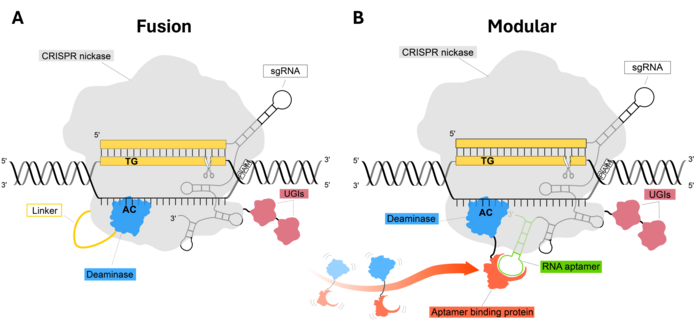
Separating those components provides more opportunities to tune editing activity and specificity. This type of flexibility allows for simplified selection of whichever nickase best positions the activity window around the target nucleotide. Deaminases can be intentionally selected based on the catalytic properties and sequence preferences of each enzyme. Because the deaminase is not fused to the nickase, the amount delivered can be adjusted without simultaneously changing the amount of nickase.
Experiments with the Pin-point base editing system illustrate how these component choices influence editing profiles (Figure 2). Changing the CRISPR nickase while holding the guide and deaminase constant shifted the positions within the target that were most efficiently edited. Changing the deaminase while keeping the nickase constant produced distinct editing windows and sequence preferences.
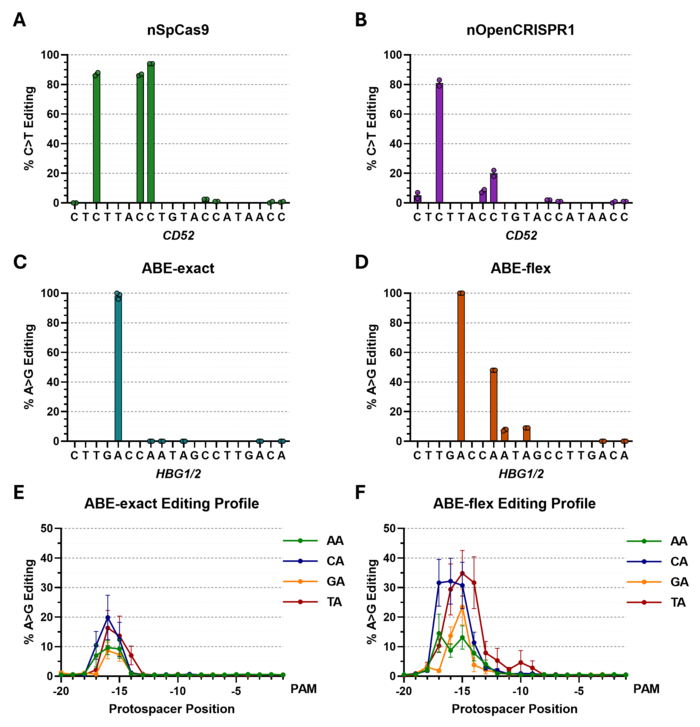
The individual components therefore become part of the design space for each edit rather than a fixed property of the editor. Choosing the right components is one aspect of optimization, but modular systems like the Pin-point platform also allow for additional areas for improved editing outcomes, especially when considering editing precision.
A base editor can locate the target DNA and still have more than one editable nucleotide within its activity window. When several editable bases sit within reach of the deaminase, neighboring bases can be converted along with the intended target, making bystander editing one way to assess how changes in editor architecture affect editing outcomes. With a fusion editor, changing the amount of editor changes the nickase and deaminase together. With a modular system, the CRISPR nickase can be held constant while deaminase levels are adjusted independently. Reducing deaminase levels might be expected to reduce overall editing activity, but that is not what Revvity’s scientists observed using the Pin-point base editing platform.
At a PDCD1 splice-donor target in human iPSCs, reducing the concentration of a modular adenine deaminase preferentially reduced editing at neighboring adenines while maintaining high editing at the intended nucleotide across a defined concentration range (Figure 3). As deaminase concentration decreased, the editing profile became progressively more precise. When the same deaminase was tested as a fusion to the CRISPR nickase, reducing editor concentration did not produce the same separation between intended and bystander editing.
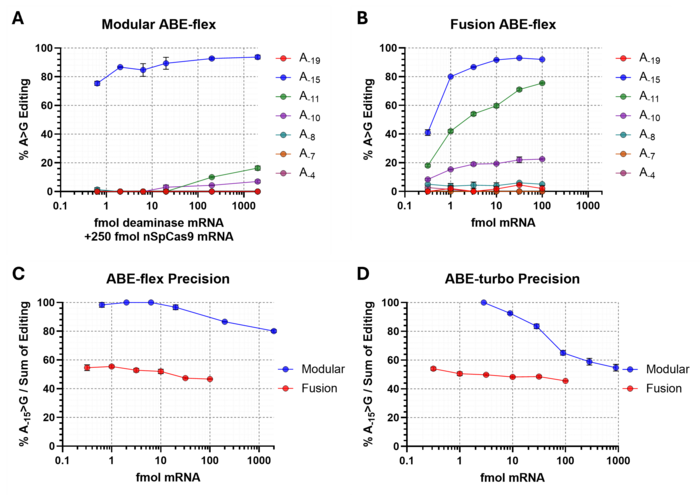
The result illustrates the relationship between editing efficiency and catalytic exposure. High levels of intended editing do not always require maximum deaminase activity. In at least some sequence contexts, there appears to be room to discover a more precise operating range with sufficient catalytic activity to efficiently edit the intended nucleotide, while limiting exposure to neighboring bases.
For a therapeutic editor, maintaining the intended edit while reducing unintended sequence changes is a valuable capability. Bystander substitutions can vary considerably in consequence. Some may have little or no apparent functional effect, while others can alter protein sequence, splicing, or regulatory elements. A recent analysis of adenine base editors estimated that when at least one bystander adenine is present within the editing window, there is a 38% probability that bystander editing will result in a nonsilent mutation.1 That finding should not be interpreted as indicating that 38% of base editing events produce harmful mutations, but rather that neighboring editable bases cannot always be assumed to be inconsequential. It also underlines the importance of continued efforts to improve editing precision.
The closer an editor approaches the intended sequence while limiting unwanted changes, the better. The practical challenge is increasing precision without compromising the editing efficiency required to achieve the therapeutic benefit.
An additional benefit of modular base editor design may be greater constraint over spurious deamination activity. DNA deaminases act on single-stranded DNA substrates, which can arise transiently during replication, transcription, and DNA repair, as well as when a CRISPR enzyme scans the genome for potential target sequences. In a fused base editor, the deaminase is physically linked to the genome-scanning CRISPR enzyme. However, in modular systems, where the two components are expressed separately, productive editing depends on recruitment of the deaminase through the guide RNA.
This separation of genome-scanning and deamination activities, together with the ability to deliver overall significantly lower levels of deaminase molecules (often around 100-fold less with the Pin-point platform), may reduce opportunities for deaminase activity outside a productively assembled editing complex. Experimental observations are consistent with these features contributing to lower spurious editing activity (Figure 4).
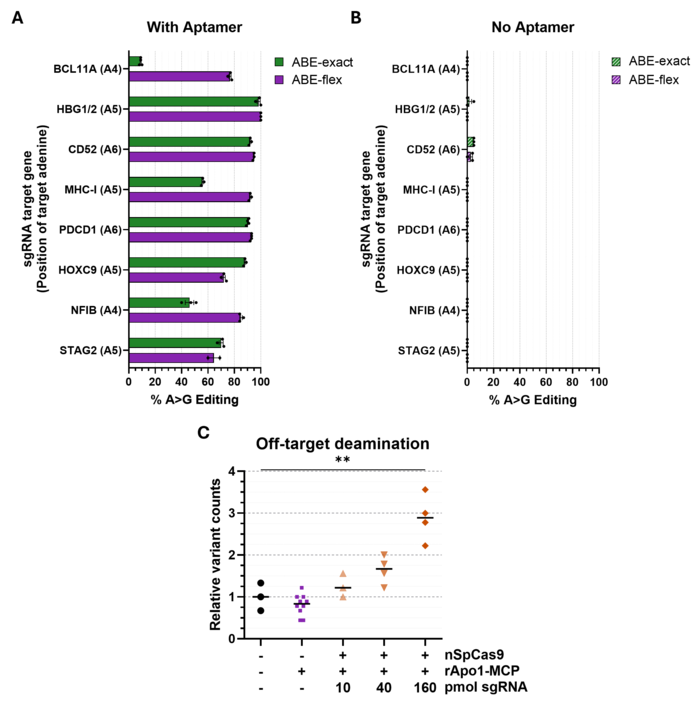
While the exact mechanisms remain under investigation, these findings support a model in which the combination of deaminase abundance and full complex assembly can influence the likelihood of spurious editing events. Importantly, independent expression of the deaminase did not result in increased observed spurious deamination, suggesting that modular assembly may provide another way to constrain unintended editing and improve the precision of therapeutic base editing.
The value of additional precision becomes easier to appreciate as base editing moves into increasingly ambitious therapeutic settings. When correcting a disease-causing variant, the desired nucleotide change is itself the therapeutic mechanism, placing a high premium on edit purity. In HSPCs and other stem cell applications, edited genomes may persist through long-term self-renewal and differentiation. Multiplex cell engineering can introduce several intended changes into the same genome, making it especially important to understand the full editing profile associated with each target. For in vivo editing, there is no opportunity to select the cleanest edited cells before treatment. These applications require characterization and optimization at multiple levels, including guide selection, nuclease and deaminase engineering, appropriate delivery and exposure, rigorous characterization of unintended editing, and editor designs that provide additional ways to shape the final editing profile.
Modular assembly adds several such options, as nickase and deaminase components can be selected independently, and deaminase abundance can be adjusted without simultaneously reducing the targeting nickase component. Productive editing depends on recruitment of the components through the guide RNA, creating another means of constraining where active editing complexes form. These features sit alongside the developments already happening across the base editing field. Advances in enzyme engineering, guide design, and delivery remain central to improving base-editing performance. The opportunity is to combine those advances with a system that gives researchers more ways to independently tune the factors that contribute to the precision of editing at the target.
Base editing was developed to enable targeted nucleotide conversion without introducing a DNA double-strand break. The therapeutic possibilities have grown considerably from there. What comes next may be less about finding a single breakthrough editor and more about leveraging each component of the base editing system to achieve the most precise and efficient edits possible.
Learn more: Revvity's whitepaper, ‘When precision editing isn't precise enough: the hidden risk of unintended edits in base editing’, takes a deeper look at bystander editing, off-target activity, and spurious deamination, and explores how modular editor design can provide additional layers of precision for therapeutic base editing.
The Pin-point™ base editing platform technology is available for clinical or diagnostic study and commercialization under a commercial license from Revvity.
References