Preclinical: Prime Editing Restores...
CMN Special
Oct. 7, 2026
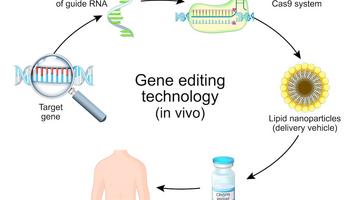
Ionisable lipid libraries have almost always been screened with short reporter transcripts such as firefly luciferase mRNA (~1.7 kb), a poor proxy for the 5-6 kb messages encoding Cas9 or base editors. A Toronto-led team therefore synthesised 384 ionisable lipids and compared delivery of 1.7-kb firefly luciferase mRNA with a 5.7-kb ABE–NanoLuc construct.
The screen selected a chemically distinct class of carriers led by LC-1, built around a cyclic headgroup and a branched tert-butyl linker. Formulated for route-specific deliveryin Ai9 reporter mice, two doses of LC-1 carried CRISPR-Cas9 mRNA and guide RNA to 79% of hepatocytes after intravenous dosing, 48% of neurons after intrathecal injection and 27% of lung epithelial cells after intratracheal instillation – up to fourfold above the benchmarks ALC-0315 and LP-01.
A single intravenous dose of ABE8.8-m targeting Pcsk9 yielded 79.5% A-to-G editing in mouse liver and reduced plasma PCSK9 by 85.7% over 60 days. LC-1 also edited human PCSK9 in liver-humanised mice, the R553X allele of CFTR in a cystic-fibrosis mouse model and Ube3a-ATS in mouse brain.
Small-angle X-ray scattering and cryo-electron microscopy indicated that LC-1 binds RNA more strongly, retains a fusogenic inverted-hexagonal structure and releases about twice as much mRNA into the cytosol as comparator LNPs.
The study was led by Songtao Dong, Fanglin Gong, Tyler Thomson and Bowen Li at the University of Toronto. It was published in Nature Biotechnology on 28 September 2026.
To get more CRISPR Medicine News delivered to your inbox, sign up to the free weekly CMN Newsletter here.
ArticleCMN BriefsNewsCMN BriefsDeliveryDelivery - BrainIn vivoLipid-based nanoparticleCRISPR ScreensBase editorsCas9