Preclinical: Prime Editing Restores...
CMN Special
Oct. 7, 2026
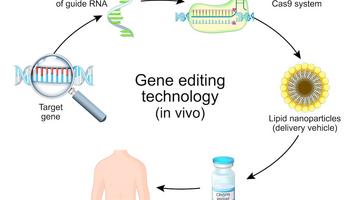
Prime editing couples a CRISPR-Cas9 nickase to a reverse transcriptase and writes a new sequence from a template carried in the guide RNA, but systemic non-viral delivery has been held back by the fragility of that long RNA. Conventional pegRNAs are protected only at their ends.
The team instead modified every region – spacer, scaffold, reverse transcription template, primer binding site and the evopreQ1 stabilising motif – with 2′-O-methyl, 2′-fluoro and phosphorothioate chemistry, testing each region separately in HEK293T cells before combining the best patterns into a guide they call Sem⁺-epegRNA. Delivered as RNA in lipid nanoparticles with prime editor mRNA and a nicking sgRNA, a single intravenous injection edited 67% of bulk mouse liver at Pcsk9.
At 1 mg/kg, a dose within clinical reach, editing reached about 51% against 0.6% for end-modified pegRNA, lowering serum Pcsk9 by 96% and cholesterol by 60%. Editing at Ttr exceeded 60%, and a lung-targeted formulation reached 20% at Dnmt1 after two doses. The same dense modification improved MS2, boxB and mpknot motifs, Cas9 sgRNAs and split adenine base editors by up to 11-fold, with off-target activity essentially unchanged across 78 predicted sites.
The study was led by first authors Xinlin Lei, Didi Chen, Kun Zhang and Xiyu Liu and senior author Hao Yin at Wuhan University. It was published in Nature Biomedical Engineering on 11 September 2026.
To get more CRISPR Medicine News delivered to your inbox, sign up to the free weekly CMN Newsletter here.
ArticleCMN BriefsNewsCMN BriefsIn vivoLipid-based nanoparticleOff-targetBase editorsCas9Prime editors