Preclinical: Prime Editing Restores...
CMN Special
Oct. 7, 2026

Efforts to improve recombinase-mediated integration have mostly targeted the enzyme, where activity-boosting mutations cluster at the DNA-binding interface and risk off-target consequences. This work instead engineered the DNA. Reshuffling the motif blocks of the four natural Bxb1 att half-sites gave 144 chimeric attB variants, each carried on its own donor DNA.
In HEK293T cells, prime editing was used to install an attP landing site at the TRAC locus, and Bxb1 then integrated the panel of modified donors. All 144 variants were still recognised by the enzyme, but their activity spanned a twentyfold range. The best variant, attB(V111), reached 52% integration – 1.7-fold over wild-type attB. The same two-step logic resulted in 36% integration at GSH1 in rice protoplasts, a 4.4-fold increase.
A parallel screen of over 3,000 Bxb1 catalytic-domain mutants, run in planta in tobacco leaves, yielded the R2Q and V76C protein variants, whose gains proved additive with those from the att sites.
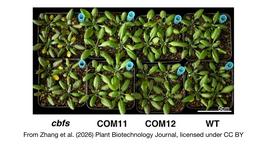
In whole plants the engineered sites changed places: a single plasmid delivered the prime editor, donor and R2Q enzyme into rice calli, installing attB(V111) upstream of the native OsEPSPS gene. The donor, flanked by attP sites, was a cisgenic herbicide-resistant version of OsEPSPS.
Twenty-four per cent of regenerated plants carried precise integrations. They were herbicide resistant and passed the insert on in Mendelian fashion. Nanopore sequencing detected no additional donor integrations or off-target insertions in the two plants examined.
The study was led by Linlin Yan and Kevin Zhao at Qi Biodesign, China. It was published in Nature Biotechnology on 2 September 2026.
To get more CRISPR Medicine News delivered to your inbox, sign up to the free weekly CMN Newsletter here.