CMN Weekly (20 February 2026) - Your Weekly CRISPR Medicine News
CMN Intelligence - The World’s Most Comprehensive Intelligence Platform for CRISPR-Genomic Medicine and Gene-Editing Clinical Development
Providing market intelligence, data infrastructure, analytics, and reporting services for the global gene-editing sector. Read more...
Top picks
- YolTech Therapeutics reports interim data showing that its CRISPR-Cas adenine base editor, YOLT-202, increased circulating alpha-1 antitrypsin in PiZZ patients with alpha-1 antitrypsin deficiency. In a first-in-human dose-escalation study, single intravenous doses (35 mg, 45 mg) produced rapid, dose-dependent rises above the 11 μM protective threshold, reaching normal levels at 45 mg, with >95% corrected M-AAT. Treatment was well tolerated, supporting planned IND submission.
- A Perspective in Nature Biotechnology examines how overlapping CRISPR patents and exclusive licensing restrict access across therapeutic and agricultural applications, despite strong market expansion. Focusing on the CVC–Broad dispute and surrogate licensing models, the authors argue that fragmented intellectual property inflates transaction costs. They propose operationalising a ‘right to science’ to mandate conditional, non-exclusive access and promote socially beneficial innovation.
Research
- Researchers engineered evoCas12f, an optimised variant of the compact CRISPR-Cas12f system, through bacterial library screening and mammalian cell validation. Five key mutations expand PAM recognition from TTTR to NTNR/NYTR, reducing the median distance between neighbouring PAM sites to 2 nucleotides in the human genome and boosting editing efficiency up to 91%. The system also supports transcriptional activation and precise base editing, broadening its utility for therapeutic genome engineering and AAV-delivered gene therapy.
- A TadA-embedded adenine base editor delivered via dual AAV corrected the recurrent CHD3 variant p.R1025W in a humanised mouse model of Snijders Blok–Campeau syndrome. Efficient A•T-to-G•C editing across cortical and hippocampal regions restored protein levels and ameliorated social, cognitive and motor deficits in vivo. Intrathecal delivery in non-human primates confirmed widespread neuronal transduction, supporting the translational feasibility of this CRISPR-Cas base editing approach.
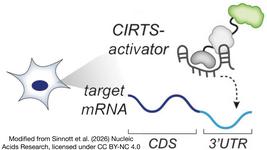
- Researchers have engineered CIRTS-4GT3 – a compact, fully human translational activator built on the CRISPR–Cas-inspired RNA-targeting system (CIRTS) platform. The activator boosts protein output from haploinsufficient genes by targeting their mRNA with a programmable guide RNA. Delivered by AAV to a Dravet syndrome mouse model, it increased NaV1.1 protein levels and significantly improved survival and seizure resistance.
- Dual-locus homology-directed CRISPR editing at TRAC and CD4 was used to redirect regulatory T cells towards class I-restricted islet antigens as a potential therapy for Type 1 diabetes. The engineered CD4-to-CD8 TCR Tregs maintained stable phenotypes and in vitro suppressive function, with TCR specificity proving critical for tissue-specific trafficking in vivo, supporting the potential of antigen-specific Treg therapies for T1D.
- Using an optimised high-efficiency CRISPR knock-in methodology, researchers engineered T cells with constitutive or conditional TCF1 overexpression to probe whether this transcription factor can de-differentiate terminally exhausted CD8+ T cells in vivo. Only constitutive — not conditional — over-expression expanded the stem-like T cell pool, demonstrating that while TCF1 can slow differentiation, it is insufficient to revert more committed exhausted subsets to a stem-like state.
- The Lithuanian lab of Virginijus Siksnys reports cryo-EM structures of the Streptococcus thermophilus Type II-A prespacer selection supercomplex, capturing Cas9 in DNA-scanning and two distinct PAM-bound configurations. The structures illuminate how Cas9 mediates prespacer selection during CRISPR-Cas adaptation, demonstrating its plasticity in being repurposed by the acquisition machinery — distinct from its canonical interference role.
- In a related study published back-to-back, Chinese researchers present cryo-EM structures of the Enterococcus faecalis Cas9–Csn2–Cas1–Cas2 supercomplex in apo and DNA-bound states, revealing the structural basis of Type II-A spacer acquisition. Cas9 interrogates the PAM sequence as it slides along DNA, and its subsequent dissociation triggers a reconfiguration that exposes the PAM-proximal end for Cas1–Cas2-mediated prespacer processing – elucidating how PAM recognition is coupled to adaptation fidelity.
- Polyvalent guide RNAs (pgRNAs) designed to simultaneously target multiple related sequences within human coronavirus 229E were delivered alongside CRISPR-Cas13 into infected human lung epithelial cells, achieving greater viral suppression than conventional single-target guide RNAs. The pgRNAs also exhibited reduced collateral RNase activity, suggesting improved specificity and a potentially safer therapeutic profile, advancing Cas13-based antiviral strategies against human RNA viruses.
Industry
- Scribe Therapeutics and Eli Lilly and Company report a second development milestone in their collaboration, advancing in vivo gene-editing programmes for neurological and neuromuscular disorders. CRISPR-Cas X-Editor technology underpins the effort, with an engineered CasX nuclease delivering over 100-fold higher cellular editing than its natural counterpart, alongside improved specificity and stability, validating Scribe’s iterative CRISPR by Design™ platform.
- Cellares and the University of Wisconsin School of Medicine and Public Health are advancing a CRISPR-Cas–edited GD2 CAR-T therapy towards clinical manufacturing. The electroporation-based approach engineers patient T cells to target GD2+ solid tumours, initially high-grade gliomas. Cellares will deploy its automated Cell Shuttle™ and Cell Q™ platforms and support CMC documentation for an IND submission, aiming to accelerate reproducible, GMP-compliant translation into early-phase trials.
Delivery
- Chondrocyte affinity peptide-modified MSC-derived exosomes were engineered to deliver CRISPR-Cas9 components for targeted knockout of the ASPN gene in osteoarthritis-affected chondrocytes, achieving a 61.7% reduction in ASPN expression. Both in vitro and in vivo, this bioinspired delivery platform alleviated ferroptosis, reduced chondrocyte senescence, and improved the cartilage microenvironment, highlighting exosome-mediated CRISPR-Cas9 delivery as a promising precision therapy for osteoarthritis.
- A drinkable methylcellulose/xanthan gum foam was developed to localise mRNA lipid nanoparticles encoding Pseudomonas exotoxin A to oesophageal tumours. In vitro, this formulation achieved 110-fold greater tumour regression than suspension delivery and potentiated radiotherapy. Although not CRISPR-Cas-based, the study illustrates localised gene therapy as a minimally invasive strategy to palliate dysphagia and enhance treatment efficacy in oesophageal cancer.
Screening
- Genome-wide CRISPR-Cas9 screening identified ATOX1 as a critical driver of cisplatin resistance in liver cancer, with high expression linked to poor prognosis. Virtual screening identified compound 8 as a potent ATOX1 inhibitor that synergises with cisplatin by promoting intracellular copper accumulation, which suppresses the NOTCH1/HES1 signalling pathway. Knockdown of ATOX1 enhanced cisplatin sensitivity in vitro and in vivo, suggesting a novel strategy to overcome drug resistance.
- Genome-wide CRISPR screens identified ILF3 as the RNA-binding protein connecting cytoplasmic mRNA decay to nuclear transcription during transcriptional adaptation, with artificial recruitment via dCas13 confirming its role in promoting adapting gene expression. Tiling oligonucleotide screens further identified trigger RNA fragments that activate adapting genes in a sequence-homology-dependent manner, informing the design of programmable oligonucleotides for gene expression augmentation.
- A high-throughput GFP reporter screen of small molecules identified CBL0137 as an enhancer of CRISPR cytosine base editor efficiency, improving editing at endogenous target sites by up to 80% through activation of the p53 pathway and inhibition of NF-κB. The compound showed selectivity, boosting cytosine base editors broadly while enhancing only multi-site mutations and fragment insertions in prime editors, offering a strategy to improve the clinical translation of next-generation base editing tools.
- Analysis of large-scale CRISPR-Cas9 screening data identified ACSL4 as a selective vulnerability in KMT2A-rearranged AML, with functional validation via CRISPR interference and shRNA knockdown confirming that ACSL4 loss impairs the growth of KMT2Ar but not non-KMT2Ar AML cells. Multi-omics profiling linked this dependency to depletion of polyunsaturated lipid species, while a derived KMT2Ar–ACSL4 dependency signature correlated with KMT2Ar status and predicted poor survival in AML patients.
- A two-step CRISPR-dCas9-based proteome profiling approach was used to map proteins associated with the B4GalNT1 (GM2-synthase) promoter, identifying p300, a histone acetyltransferase, as a pivotal transcriptional regulator. p300 drives GM2-synthase expression by promoting acetylation-mediated degradation of SP1 while simultaneously activating SMAD2/4, uncovering a critical p300–SMAD–SP1 regulatory axis underlying the overexpression of this pro-tumorigenic ganglioside in cancer.
Detection
- LAMP-coupled CRISPR-Cas12a assays targeting 18S rDNA and kinetoplast DNA were developed and optimised for portable, field-deployable detection of Leishmania infections, replacing PCR preamplification with loop-mediated isothermal amplification. Validated against 90 clinical skin lesion samples from Peru, the assays achieved a sensitivity of up to 90.9% and 100% specificity with both fluorescence and lateral flow readouts, offering a promising next-generation diagnostic tool for leishmaniasis surveillance in low-resource settings.
- Two CRISPR-Cas12a-integrated biosensors were developed using commercial pregnancy test strips to enable instrument-free visual detection of telomerase activity and miRNA let-7a as cervical cancer biomarkers. Both biosensors achieved detection limits of 18 HeLa cells and 25.1 fM, respectively, and were validated against clinical tissue and blood samples, demonstrating concordance with gold-standard methods, offering a low-cost point-of-care screening solution for resource-constrained settings.
Perspectives
- An editorial in Molecular Therapy Oncology highlights results from a first-in-human clinical trial using CRISPR-Cas9 knockout of CISH in autologous tumour-infiltrating lymphocytes, which achieved a complete and durable response in a patient with refractory metastatic colorectal cancer. The authors argue that chronobiology and high-frequency ctDNA monitoring could help optimise future CRISPR-engineered cell therapy trials and more rapidly distinguish responders from non-responders.
Reviews
- Computation and deep-learning-driven advances in CRISPR genome editing. This review examines how computational approaches — including deep learning, physics-based simulations, graph neural networks, and generative models — are advancing the engineering, optimisation, and mechanistic understanding of CRISPR-Cas genome-editing systems.
- Toward precision immunotherapy: In vivo gene editing of T, NK, and myeloid cells. This review discusses the emerging field of in vivo immune engineering, highlighting its therapeutic potential, key technological and translational challenges, and the considerations required to safely and effectively bring such strategies into clinical practice.
- CRISPR as a therapeutic tool for inherited retinal degenerations: Advances, challenges, and future directions. This review examines how CRISPR-based genome editing is being applied to inherited retinal diseases, summarising preclinical and early clinical advances across diverse editing modalities and discussing the translational challenges that must be addressed to enable safe and effective therapeutic implementation.
- Label-Free MicroRNA Diagnostics: From CRISPR Nucleases to Nanomaterial-Enhanced Transducers. This review surveys advances in label-free microRNA biosensing that integrate CRISPR-based molecular recognition with nanomaterial-enabled signal transduction, highlighting innovations in sensitivity, specificity and multiplexing, and discussing translational challenges and emerging strategies for portable, amplification-free diagnostic platforms.
- Miniaturized CRISPR: Ultra Compact Systems for In Vivo Delivery and Portable Diagnostics. This review summarises progress in compact Cas protein engineering, guide RNA optimisation, and delivery vector miniaturisation, and highlights their impact on therapeutic gene editing and portable diagnostic platforms.
News from CRISPR Medicine News
- In a Clinical Trial Update on Wednesday, we reported about Precision BioSciences' investigational in vivo gene-editing therapy for Duchenne muscular dystrophy (DMD), PBGENE-DMD, that has got a FDA Study May Proceed notification. It is the first in vivo gene-editing approach specifically designed to target the common exon 45–55 hot-spot, and one of the first to move into clinical testing.
To get more CRISPR Medicine News delivered to your inbox, sign up to the free weekly CMN Newsletter here.

Revvity and Profluent are opening access to next-generation base editing. Through the AI-enhanced Base Editing Access Program, selected researchers can receive complimentary evaluation services to assess the new AI-engineered adenine base editors integrated within Revvity’s modular Pin-point™ base editing platform. Our goal is simple: To empower therapeutic development teams to explore how modular, high-precision base editing can advance their programs - without the usual barriers to entry. Apply today! Deadline 6 February 2026
“The European Genomic Medicine Consortium is quietly gathering under the CMN umbrella. Exploring the frontier of gene editing for therapeutic precision - this network is not public yet, but it’s real. Watch the signals, track the sequences. Only those who search will know.”R
Tags
ArticleNewsCMN WeeklyAlpha-1 Antitrypsin Deficiency, AATDPolicyBase editorsEli LillyScribe TherapeuticsYolTech TherapeuticsClinical
CLINICAL TRIALS
Sponsors:
Base Therapeutics (Shanghai) Co., Ltd.
Sponsors:
Base Therapeutics (Shanghai) Co., Ltd.