CMN Weekly (5 December 2025) - Your Weekly CRISPR Medicine News
By: Gorm Palmgren - Dec. 5, 2025
Top picks
- British researchers have shown that BK polyomavirus infections of bladder tissue induce APOBEC3 enzymes in uninfected bystander cells via paracrine interferon signalling, causing them to acquire cancer-initiating mutations, termed "transmutagenesis". CRISPR-Cas9 knockout experiments confirmed APOBEC3A and APOBEC3B were essential for these mutational signatures, which matched those in muscle-invasive bladder cancers, suggesting many urothelial carcinomas may arise through this virus-triggered but virus-absent mechanism.
- A new method, FAME-CRISPR, combining pan-histone deacetylase inhibitors – particularly panobinostat – with engineered virus-like particle delivery, achieved 4-fold higher CRISPR-Cas9 editing efficiency compared to previous approaches. The technique generated significantly edited cell populations within 2–3 doublings in both immortalised cancer cells and primary diploid fibroblasts, eliminating the need for single-cell cloning and selection.
Research
- A new platform, dCasCMA, combines dCas13d with chaperone-mediated autophagy targeting motifs and customisable guide RNAs to degrade specific RNAs in mammalian cells efficiently. The platform successfully targeted both exogenous and endogenous RNAs, with multiplexed guide RNA arrays enabling simultaneous degradation of multiple targets during viral pathogenesis, both in vitro and in vivo.
Industry
- An Advertorial in Nature reports that researchers at Syntax Bio have developed Cellgorithm. This CRISPR-based platform uses sequential proGuides to activate endogenous transcription factors via CRISPRa and CRISPRi, enabling stem cell differentiation in approximately 7 days. The system operates two to tenfold faster than conventional directed differentiation using transient plasmid delivery, reducing manufacturing costs by four to twentyfold.
Clinical & preclinical
- CorriXR Therapeutics, in collaboration with InhaTarget and Merxin Ltd, is using its CRISPR-Cas platform to disable NRF2, a key driver of lung tumour drug resistance. The gene-editing therapy will be delivered via inhalation using InhaTarget's lipid nanoparticles and Merxin's precision inhalers. Preclinical models show restored chemosensitivity with minimal off-target effects. First in vivo results are expected mid-2026.
- Regeneron Pharmaceuticals and Tessera Therapeutics have formed a global partnership to develop and commercialise TSRA-196, Tessera's lead in vivo Gene Writing™ therapeutic for alpha-1 antitrypsin deficiency (AATD). The program is designed to precisely repair disease-causing mutations in the SERPINA1 locus using Tessera's proprietary RNA-based Gene Writers delivered via a non-viral lipid nanoparticle (LNP) system. Also, read our take on the story.
- AvenCell's trial clearance advances AVC-203, a CRISPR-Cas-engineered allogeneic CAR-T designed for dual CD19/CD20 targeting in relapsed or refractory B-cell malignancies. Editing supports immune evasion, improves T-cell fitness, and enables a switchable RevCAR system for future antigen expansion. The multi-phase study will assess safety and efficacy, aiming to deliver scalable, off-the-shelf CAR-T performance comparable to leading autologous products.
Delivery
- Researchers have developed two engineered virus-like particle envelopes for in vivo CRISPR editing of human haematopoietic stem and progenitor cells: an optimised BaEVTR VLP achieved 31% editing of B2M and induced fetal haemoglobin through BCL11A and HBG1/2 editing, whilst a CD133-targeted envelope provided higher HSPC specificity. Both VLPs avoided human hepatocytes in a humanised liver model.
- A new peptide-based delivery system, Neuro-PERC, enabled efficient CRISPR editing of neurons in the brains of mice and large animals via convection-enhanced delivery, representing a non-viral alternative to viral vectors. The approach was well tolerated and extended survival in a preclinical mouse model of Huntington's disease, potentially accelerating the clinical translation of CRISPR therapies for neurological disorders.
Screening
- Using a genome-wide CRISPR-Cas9 screen with an HBV reporter virus expressing red fluorescent protein, researchers identified 63 candidate host proviral factors required for hepatitis B virus infection in HepG2-NTCP/Cas9 cells. Validation confirmed 12 genes that significantly decreased HBV replication, including the novel metabolic factor MOGAT2, whose inhibition impaired viral transcription and replication.
- Japanese researchers have developed a screening system using diphtheria toxin resistance to identify CRISPR-Cas9 variants with enhanced homology-directed repair activity. By screening a library of SpCas9 variants carrying random mutations in the nuclease domain, they identified HSS Cas9, which harbours two previously unreported mutations (I795V and K918E).
- An in vivo CRISPR screening pipeline using genetically editable progenitor cells screened over 100 cytokine receptors in mouse models of multiple sclerosis, identifying interferon-γ, tumour necrosis factor, GM-CSF and TGF-β as essential regulators of macrophage polarisation. Single-cell transcriptomics and Perturb-seq analyses revealed conserved neuroinflammatory cytokine signatures across myeloid populations and species, elucidating the cytokine cues that shape macrophage function in MS.
Detection
- A new CRISPR-Cas3-based point-of-care diagnostic platform for monkeypox, Kairo-CONAN, uses disposable hand warmers and freeze-dried reagents for field deployment. The system achieved rapid, high-sensitivity detection of MPXV DNA across multiple clades (Ia, Ib, and IIb) through optimised probe configurations and clade-specific CRISPR RNAs, with results visualised via lateral flow assay strips.
Perspectives and opinions
- A Forum in Trends in Biotechnology discusses how CRISPR-based forward genetic screens enable systematic discovery of engineering targets that improve mammalian cell production of complex biotherapeutics, including bispecific antibodies, fusion proteins and viral vectors. The authors highlight future integration of single-cell transcriptomics and artificial intelligence to enhance predictive power and accelerate development of modality-specific cell factories.
- Following a recent death in Intellia Therapeutics' clinical trial of intravenous LNP-CRISPR therapy for transthyretin amyloidosis, researchers propose fractionated intra-arterial hepatic artery delivery as a safer alternative for liver-targeted gene editing. This approach would sequentially treat discrete liver segments over multiple sessions spaced 2–4 weeks apart, preserving hepatic reserve whilst lowering peak exposures and enabling adaptive dosing.
Conferences
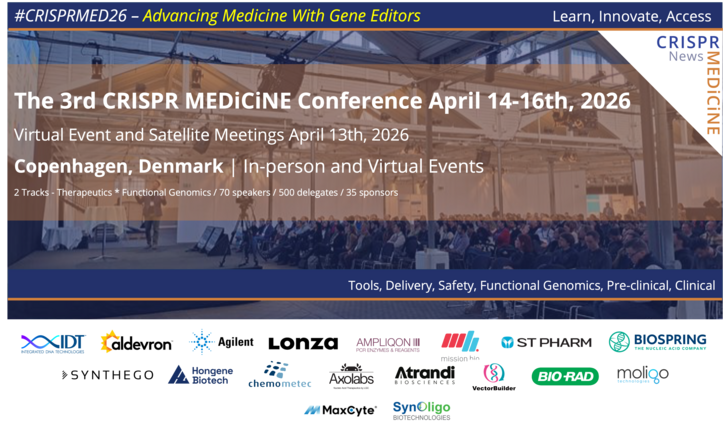
- Early Bird registration for the CRISPRMED26 conference in Copenhagen next April closes on 8 December. So act now to secure your discounted rate and join global leaders in CRISPR and genomic medicine. Abstract submissions remain open until 12 January 2026.
Reviews
- Functional classification of platelet gene variants using CRISPR HDR in CD34+ cell-derived megakaryocytes. This review outlines how the CRIMSON HD CRISPR-Cas platform enables precise, lineage-specific functional classification of platelet-related genetic variants, thereby improving the interpretation of inherited platelet disorders.
- CRISPR/Cas9 Genome Editing in Oncology: Mechanisms, Therapeutic Platforms and Translational Challenges. This review surveys how CRISPR-Cas9 is reshaping oncology – from functional screens and cancer modelling to multiplex-edited and in vivo CAR-T systems – while detailing delivery, fidelity and immunogenicity challenges that still constrain clinical translation.
- A review of recent studies on CRISPR/Cas9-mediated genome editing in a variety of muscle-related genetic disorders. This review examines how CRISPR-Cas9 is advancing mechanistic insight and therapeutic development for inherited myopathies and muscular dystrophies, highlighting its potential to correct diverse muscle-related mutations and enable more effective, personalised interventions.
To get more CRISPR Medicine News delivered to your inbox, sign up to the free weekly CMN Newsletter here.
“The European Genomic Medicine Consortium is quietly gathering under the CMN umbrella. Exploring the frontier of gene editing for therapeutic precision - this network is not public yet, but it’s real. Watch the signals, track the sequences. Only those who search will know.”R
Tags
ArticleNewsCMN WeeklyAvenCell TherapeuticsCorrixr TherapeuticsTessera Therapeutics
CLINICAL TRIALS
IND Enabling
Phase I
Phase II
Phase III
Gastric Cancer and Colorectal Cancer, CRC, (NCT07166263)
Sponsors:
Base Therapeutics (Shanghai) Co., Ltd.
Sponsors:
Base Therapeutics (Shanghai) Co., Ltd.
IND Enabling
Phase I
Phase II
Phase III
Relapsed or Refractory Acute Myeloid Leukemia, AML, (NCT06541444)
Sponsors:
Base Therapeutics (Shanghai) Co., Ltd.
Sponsors:
Base Therapeutics (Shanghai) Co., Ltd.
IND Enabling
Phase I
Phase II
Phase III